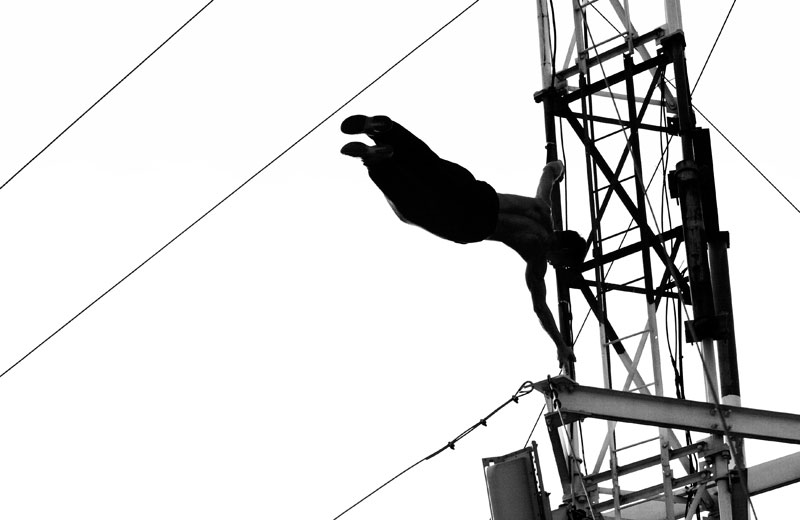
Lucy's Ideas In this section I will be researching my documentary ideas, looking at other documentaries that have also focused on the subject. I will also be reviewing and researching some of the documentaries I have seen throughout the semester, along with documentaries that are similar to our 'real life superhero' documentary idea. Idea 1: Following free runners in towns and cities, seeing the sights through their eyes and revealing the limitations (or not) of the life they lead. |
||||
"Free running or freerunning is a form of urban acrobatics in which participants, known as free runners (or practitioners, though this is a generic term used for freerunning and parkour), use the city and rural landscape to perform movements through its structures. It incorporates efficient movements from parkour, and adds aesthetic vaults and other acrobatics, such as tricking and street stunts, creating an athletic and aesthetically pleasing way of moving. It is commonly practiced at gymnasiums and in urban areas (such as cities or towns) that are cluttered with obstacles."1 The documentary would initially follow one freerunner around a town/city, with interviews from him/her that shows the 'different' ideas they have of the 'normal' way to get around. I would like some of the shots to be wide-angle, XLS to establish the town/city, but with contrasting close-up shots of the freerunners performing different movements. (This video is also available in HD here on Vimeo as well.)
Many of the influences
for my idea for the freerunning documentary came from this short, and many of
the shots I had in mind before I saw this video are comparable to the ones used
here. I think the video represents the reflexive, performative and possibly
observational documentary mode because firstly, the spectators sees the
freerunner as if they are directly looking at him and also sharing his
experiences, going to city heights that would not usually be gone to if the
documentary-maker was following an 'ordinary' person. Many of the limitations
people hold as to where they can go and what they can do in a town and city are
questioned in this video and in part of the freerunners mind; ideological
'rules' are broken by freerunners and they seem to have no limit on where they
can go - in some cases, it could be said that freerunners in cities and
towns have a wider sphere of how they see the world than the average
person, which is fascinating because the spectators of my documentary idea
could then hold some kind of wider, better opinion on the 'ugly', 'boring'
streets they may walk in everyday.
Idea 2:
Ladies' sports that are predominantly run or played by men, e.g. football and rugby. My sister plays rugby for a University team in Plymouth (UPLRFC [- University of Plymouth Ladies Rugby Football Club]) and my idea for the documentary would be to follow the team whilst also questioning socieites ideas and ideologies about sports played by women that are popularly played by men. It may be possible to go to either end of the spectrum regarding opinions held by people (It is a good thing women play sports, and the extremes of the women who participate in a 'mans' sport vs the opinion that it is not a good thing women play 'mens' sports, women should never play 'men’s’ sports and not even participate [very misogynistic!]) and because of this I could get various interviews not only with the rugby club members but also with the people who hold extreme opinions of the subject.
I have got in contact with UPLRFC's Chair Representative, Sarah Mimnagh, and
asked who I would initially need to get in contact with regarding following the
club and if the club would be happy to be in a student documentary. Outside of the lectures, I have tried to watch as many documentaries that refer to different modes and documentary practises as possible. However, I have also tried to focus on some documentaries that reflect the modes and themes that we may go with with our documentary - particularly observational and participatory. Here are a few examples: The Cove is "a classic espionage tale"2 that may be classed as an Expository Mode of
documentary, where it uses the 'voice of God' to narrate the documentary and
push the narrative forward. The voiceover used in the documentary was a
signature used throughout, alongside many other signatures such as:
The documentary could also be classed as part of the mode of Political Reflexivity because it is trying to change people’s opinions of the specified subject. For example, right at the end of the documentary, a URL is shown of a petition to stop the dolphin hunting in Japan. Many people have signed this petition because of The Cove which shows just how much of an impact the documentary has had on its viewers. Furthermore, the documentary questions the morals society holds over the anthropological need to ‘teach’ the dolphins something and the way society sees whale and dolphin parks and aquariums. Many ‘truths’ are hidden from society, and this documentary searches for those truths, and even though it may be horrible and something society do not particularly want to see, the truth is shown quite bluntly. Catfish (2010, Schulman & Joost) The documentary uses Participatory and Reflexive documentary modes to put across its narrative. The main participator of the documentary, Nev, interacts with the audience through blog-style footage. This is also called ‘vlogging’ and is quite a popular way to tell a story over the internet and speak to someone else (especially with programs like Skype/MSN Messenger etc). This signature worked in this documentary because the main theme of the documentary itself was human interaction, specifically the post-modern way people used social networking sites to contact each other. This also added a sense of realism to the documentary because it seemed as if Nev was personally interacting with the viewer, telling his story so the viewer could follow as if they were in the situation as well. Many visual signatures were used in Catfish, such as ‘real life’ Google map views, moving the image to show the journey they would go on, images with text, especially Facebook-style text showing their name and popular Facebook buttons, such as ‘Confirm Friend’, ‘Message’ etc., all shown in the trailer above. The signatures were usually matched with a voiceover, usually Nev’s voice which also carried the narrative on, helping the audience keep up with what was happening in the situation. The use of modern technology shown in this documentary was interesting because it related to the documentary’s demographic – probably both male and female American people, aged around 16-25. I do not think the demographic would go much higher than 25, however, because of the way social networking sites are so popular within this age range. 127 Hours (2010, Danny Boyle) This documentary is what is known as a 'dramadoc', where techniques are used that are derived from fiction cinema to reconstruct an actual event. E.g. using specific shots, non-diegetic soundtrack. Visual Signatures Subtitles - telling the audience what day/hour it is. Keeps audience up to date with the main character's timeline. Long shots - specifically of the canyon itself, as seen in the trailer as well. Puts main protagonist in a small scale. This is a fiction cinema technique - the long shot creates a sense of loss, makes the character look extremely small compared to his surroundings. Split screens - A fiction cinema technique, creating a visual effect for the audience. It could also be argued that the documentary focuses on the genre of the autobiographical, where it focuses in on one person and their story on a particular event that changed their lives. However, even though the genre is distinguishable, I do not think there is any mode of documentary that stands out above the rest. It does not address a specific issue apart from the event it portrays and reconstructs. It could be argued it is observational, but the events played out are extremely staged and put on for the audience. I also think you could argue that the documentary itself could be sold on the basis that Danny Boyle was the director - the selling of the documentary was sold through audience recognition of a 'star' instead of the event that happened. The next few documentaries are ones found and researched into because they reflect some of the ideas we want to go with. There are also a few TV programmes that I will brush over, because they are also influencing our idea for our documentary and focusing on the same subject. Superhero Me (2010, Sale) "This fly on the wall documentary follows film maker Steve Sale on
his journey to becoming the real life superhero known as SOS. Some of the modes and styles to be aware of in this documentary are observational and reflexive. This is helpful towards our overall documentary because we would be focusing on the observational mode, but would steer away from the reflexive mode as we want to keep a level-head and non-biased opinion, which would ultimately be shown to the audience so they could make their own minds up about the phenomenon and the people involved. However, with this documentary, I think both modes worked well and complemented each other, because it was following how one man could become a superhero whilst also getting interviews with comic book fans and experts, such as The Justice Force Five and Master Legend, a well known real life superhero in the U.S.A. Alongside the observation and reflexive mode, the documentary used the Voice of God narration, which was from the filmmaker and main subject of documentary. This is interesting to note because if there had been another voice with the voiceover the audience may have felt like they were not 'part' of the journey that the documentary was following, but because it was the same person in front of the camera and doing the voiceover, it could be argued that the audience felt like they were being personally involved with the documentary. This was also emphasised by the mediocre shots that were sometimes with a handheld camera, sometimes even shot on a mobile phone camera or whatever was available. This just shows then, that a good documentary can be made out of footage that may not be of such a high standard than the common cameras some documentary makers use. Confessions of a Superhero (2007, Ogens) This documentary is alike and different from Superhero Me in many ways. Firstly, the way that it resembles Superhero Me is seen in the way it uses the observational mode to follow and interview four people, not only looking at when they dress up as superheroes but also documenting their personal lives (for example, SuperMan's wife is interviewed and their marriage proposal is caught on camera in the documentary). This is interesting to show because it gives the real life superheroes a deeper identity - the audience can ultimately see that they have lives away from being superheroes, and also they can witness for themselves why the superheroes decided to become superheroes in the first place. Secondly, it is alike because it interviews experts - the four people are interviewed seperately but also interviewed when they are working together. This gives a sense of individuality but also some sort of group dynamic. On the other hand, this documentary differs from Superhero Me, too. Firstly, it seems as if the documentary focuses on the theme of obsession, rather than focusing on why they become and are superheroes. This is especially seen when they interview and follow 'SuperMan'; his wife and colleagues even state that he is obsessive over comic books and the SuperMan character. Because of the way his 'obsession' is seen through the documentary, it could be argued that he is being portrayed in a bad light, and that is something we, as a group, do not want to do to anyone that we interview. Not only is it breaking Ofcom rules and regulations but it would not be beneficial to our non-biased opinion that we are trying to convey. Secondly, this documentary is different to Superhero Me because the superheroes themselves are different to the main superhero in the previous film. These superheroes dress up as superheroes to earn a living, whereas in Superhero Me, S.O.S (the superhero) was being followed because he was helping his community and neighbourhood. He was not doing this for money, furthermore to earn a living; he was doing it because he wanted to do something good for his community. The superheroes in this documentary may be dressing up as superheroes, but the documentary does not show them doing any good deeds towards their community apart from being photographed for 'tips'. References:
1 - http://en.wikipedia.org/wiki/Free_running, accessed on 12/10/11. |
||||