Lucy - Documentary Processes In this page I will be exploring the differing documentary knowledge I have gained from the module and extra research/readings. I will be looking at documentary genres and styles, camera work, documentary history, practitioners, techniques, primary and secondary sources, online delivery of documentaries, media outlets, interviews, question structures, aims and objectives and pre and post production. |
||
The question of the 'real' and/or the 'truth' is still being asked today, along with the question 'what is a documentary?'. Actualities - John Grierson, 1920's, recordings of real events. 'Actualities' are "creative treatments of reality". Propaganda - Documentaries were used as a way of persuading a certain audience demographic. Wartime documentaries are an excellent example of this. Fly-on-the-wall - From the influence of the latest technology in the 1960's and onwards. Smaller, light-weight cameras, small crews, cheaper film stock, improved sound equipment and smaller microphones gave more of a 'true' response to events. As a result of this, crews are less conspicuous, developing a more intimate, direct relationship with subjects. Cinema Verite - Interacts with the object/subject to get a reaction Direct Cinema - Unobtrusive towards an object/subject, capturing reality Documentary Genres
Capturing Reality: The Art of Documentary' - here I watched a few of these videos whilst researching into the modes, themes and styles of documentary, and picked out a few quotes from some of the practitioners that I think are not only helpful in my run-up to making our film, but also full of advice to follow and take into consideration: Malcolm Clarke (Sound/Narration)
Joan Churchill (Shooting: the art of anticipation)
Malcolm Clarke (The Ideal Cameraperson)
Serge Giguere (A passion for shooting hand-held)
Albert Maysles ("Stay With It!")
Rakesh Sharma ("As if we were just having a conversation")
Rakesh Sharma (Working with two cameras)
Stan Newman (Informational Bulimia)
Scott Hicks (Asking the right questions)
Emmanuel Priou (Editing: a creative dialogue)
Patricio Guzman (Our own take on reality)
Jean-Daniel Lafond (Making sense of the world)
Primary and Secondary Sources Primary Sources A primary source is some form of material that relates directly to the original concept or idea. For our documentary then, a primary source would be the interviewees and perhaps the charities that we look at and interview, too. We have got in contact with some 'real life superheroes' (The Dark Spartan & S.O.S) and both sources seem interested in our idea. 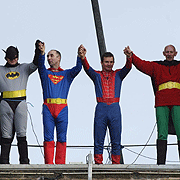 We have also got in contact with Fathers 4 Justice, who dress as superheroes in some of their petitions and they have also said they are interested in taking part in our documentary. We would ask them why they dress up as superheroes and what impact they are trying to cause when they do this. Another primary source could be Heroes Run - an event created by the charity Pass It On Africa. People dress up as superheroes and run to raise money for the charity, and we would interview them to ask why they feel the need to dress up as superheroes, and what connotations dressing up as superheroes has. Secondary Sources Secondary sources refer to pieces of material that comment upon or build upon the primary sources. In our documentary, our secondary sources would be the RLSH (Real Life Super Hero) registry and other websites that we have gained information off, along with quotations, facts and figures that we gain from our research. |
||
