Alex - Photojournalism Research |
Here is my research that I have done into photojournalism across a broad area of the subject and practice.
The Expository Mode
The expository text addresses the viewer directly, often in the form of an authoritative commentary voiceover or titles, proposing a strong argument and point of view. These films are rhetorical, and try to persuade the viewer. They try doing this by using a rich and deep male voice, this is known as the ‘voice of god’.
Night Mail 1936 produced by the GPO Film Unit, directed by Harry Watt and Basil Wright, runtime 25 minutes.
The documentary film is about a London, Midland and Scottish Railway mail train from London to Scotland. Shows the special trains on which mail is sorted, dropped and collected on the run, and delivered in Scotland overnight.
Victory at Sea 1952-1953, produced by Henry Salomon
Victory at Sea is a documentary television series that was condensed into a film in 1954. It is about naval warfare during World War II.
Observational documentaries attempt to simply and spontaneously observe lived life with a minimum of intervention. The first observational documentary date back to the 1960’s where technological developments meant that it was made possible, with mobile lightweight cameras and portable sound recording equipment for synchronized sound. Often, this mode of film eschewed voice-over commentary, post-synchronized dialogue and music, or re-enactments.
Listen to Britain 1942, by Humphrey Jennings and Stewart McAllister
Listen to Britain is a British propaganda short film. A depiction of life in wartime England during the Second World War. Director Humphrey Jennings visits many aspects of civilian life and of the turmoil and privation caused by the war, all without narration.
High School 1968, directed by Frederick Wiseman
Documentary filmmaker Frederick Wiseman takes us inside Northeast High School as a fly on the wall to observe the teachers and how they interact with the students.
Poetic documentaries, which first appeared in the 1920’s, were a sort of reaction against both the content and the rapidly maturing grammar of the early fiction film. The poetic mode moved away from continuity editing and instead organized images of the material world by means of associations and patterns, both in terms of time and space. ‘Life-like people’ were absent; instead, people appeared in these films as entities.
Sans Soleil (Sunless in English) is a 1983 French film directed by Chris Marker
A woman narrates the thoughts of a world traveller, meditations on time and memory expressed in words and images from places as far-flung as Japan, Guinea-Bissau, Iceland, and San Francisco.
Reflective documentaries don’t see themselves as a transparent window on the world; instead they draw attention to their own constructed ness. It is the most self-conscious of all the modes, and is highly sceptical of ‘realism.
David Holzman's Diary 1967, directed by Jim McBride
This fake documentary which appears quite real on the surface is about a young man making a movie about his everyday life and discovering something important about himself and his reality. This film is not a real documentary or is it.
The Man with a Movie Camera 1929, directed by Dziga Vertov.
A cameraman travels around a city with a camera slung over his shoulder, documenting urban life with dazzling inventiveness.
Participatory documentaries believe that it is impossible for the act of filmmaking to not influence or alter the events being filmed. We get a sense of how situations in the film are affected or altered by her presence. Unlike the observational mode, the participatory mode welcomes direct engagement and the filmmaker becomes part of the events being recorded.
Kurt and Courtney 1998, Directed by Nick Broomfield
A documentary on the life of Kurt Cobain and his relationship with Courtney Love.
Sherman’s March, 1986, directed by Ross McElwee
Ross McElwee sets out to make a documentary about the lingering effects of General Sherman's march of destruction through the South during the Civil War, but is continually side tracked by women who come and go in his life, his recurring dreams of nuclear holocaust, and Burt Reynolds.
The Performative Mode
Performative documentaries stress subjective experiences and emotional responses to the world, having different meanings for different people. They are strongly personal, unconventional, perhaps poetic and/or experimental, and might include hypothetical enactments of events designed to make us experience a specific perspective on the world that is not our own maybe. Performative documentary’s often link up personal accounts or experiences with larger political or historical realities.
Forest of Bliss, 1986, by Robert Gardner
The documentary film focuses about everyday life for the everyday person that lives in Benares, India.
Lewis Wickes Hine (1874 -1940)
American photographer and sociologist Lewis Wickes Hine used his camera as a tool for social reform. His child labour pictures educated the public on the use of children as laborers, leading to changes in child labour laws in the United States. With the social issued involved in so much of Hines work we can associate his work with being the expository mode with these photos being staged ontology. The manipulation of the subjects is present in the majority of his work, as in the Industrial Age of America we see the workers have been setup to portray maximum effect to the situation they are in; if we look at the some of Hines work like this image below of a boy in the middle of a work space in a factory. It you look you’ll see how the boy has been positioned and told to look down the lence of the camera, this positioning and body language is unnatural and enhances the Staged ontology.
This other photo below is an example by me of following Hines photojournalism techniques; this man is a protester during the ST Pauls Cathedral riots in London 2011. When I took this photo he was manipulated to stand there in that way by another photographer, doing this created a great photograph because it has the tents and the cathedral in the background setting the scene with all the focus then put on the man’s emotions and the words he is expressing, the expository mode can produce some beautiful photography but it is a form of art that can be spotted because the perfections that are trying to be created are just not something that exists in this modern world.


Henri-Cartier Bresson (1908-2004)
A French photographer Henri-Cartier Bresson was considered to be the father of modern photojournalism. He was an early adopter of 35 mm format, and the master of candid photography. He helped develop the "street photography" or "real life reportage" style that has influenced generations of photographers who followed. With new technology that came through into the 1960’s it meant that photographs like Bresson could sit back and observe more with his photos and did not require him to manipulate or interact. His photographs therefore are the observational mode as he observes the issues instead of staging and manipulating them. This ‘decisive moment’ photography by Bresson below of the people by the lake demonstrates that photography flows much better when it is not tamped with as less issues are raised because it is actually representing real life.
The other photograph here is my take on the decisive moment as we see two men with their arms on each while socialising at ST Pauls Cathedral. This was a short moment that I was able to capture and you see from the quality of the focus that I did not have time to set this image perfectly which just illustrates just how the decisive moment in photography works.


A Hungarian combat photojournalist who worked and shot in five different wars in his career. These being the Spanish Civil War, the Second Sino-Japanese War, World War II, the 1948 Arab-Israeli War, and the First Indochina War. Of these he most famous for the Spanish Civil War with all focus around one photo the ‘falling solider’ and then World War II because of his work he did while following the soldiers on the D- Day landings as these photos portray the violence of war with unique impact. In 1947, Capa co-founded Magnum Photos with, among others, the French photographer Henri Cartier-Bresson. With his work we see beautiful examples of decisive moment, the D day landings are properly if not the best example of it as an event like this is so rare and its representation on life could not be any further away from any form of manipulation or control. His most prestige’s photo however the ‘falling solider’ has much unrest about it, for decades people have argued about the originality of this photo to see if it was staged. For reports dated back to as recent as 2009 like that in ‘Shadows of Photography’ it is a question that will never be answered but imagining that Capa did managed to shot this then what a photograph it is/would be truly the principal of decisive moment photography.
 |  |
Eve Arnold (1912-present)
An American photojournalist Eve Arnold joined Magnum Photos agency in 1951, and became a full member in 1957. Arnold was born in Philadelphia, Pennsylvania. Her passion for photographer started roughly in 1946, when she worked for a photo-finishing plant in New York City. She may be best known for her photographs of Marilyn Monroe such as ones like on her film sets like ‘The Misfits’ but she took many photos of Monroe throughout her life and had an exhibition of unseen photos of Monroe that were displayed in London in May 2005. Arnold photographed many famous people around the world with the likes of Queen Elizabeth II, Joan Crawford and Malcolm X. she also did a series of portraits of American Presidents' wives. Her career lead to her to photograph all round the world from China, Russia, South Africa and Afghanistan. When she took photographs of colour she would like to express the colourfulness of the actual colors’ present, it was a phase that she went through and because she mainly did this with woman it worked wonders because of the colours that these women are wearing.
 |  |
Margaret Bourke-White (1904-1971)
An American photographer Margaret Bourke-White was a key part of the history of photojournalism but more importantly woman’s photojournalism. She is known for things like being the first foreign photographer to take pictures of Soviet Industry as well being the first female war correspondent. As such a pioneer for photography especially for woman it makes her work virtually important to the history of photojournalism because she was the one breaking the boundaries and coming out with beautiful images. From just these examples below we see how she was a hands on woman getting stuck in there to make sure she can capture the best stories. With her photography it makes you think that it is staged ontology because she has captured some truly unbelievable images, but at the same time because of her personality it does make you think that maybe it was decisive moment but captured at such a high level it just makes you think that.
 |  |
Jacob Riis (1849-1914)
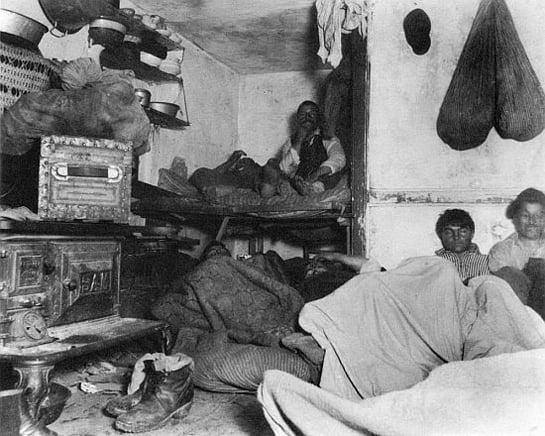
A Danish/American journalist and social documentary photographer Jacob Riis is known for using his photographic skills to aid the impoverished in New York City; those impoverished New Yorkers were the subject of most of his prolific writings and photography. Additionally, as one of the most famous supporters of the newly practicable casual photography, he is considered one of the fathers of photography due to his discovery the use of flash in photography. We can see from his DOB that he really was around at the beginning of photography and this meant therefore that he limited to what he could with the camera, that is why most of his pictures will have people standing/sitting still as moment would just cause to much problems for cameras in that day. This meant that really he was interacting with the people in a staged manner, but it was the technology that made him have to do this instead of it being just a personal choice. With his photos just like below he is still able to capture some really nice moments but the sense of control lingers all over his photos.


(1).jpg)