Walker EvansWalker Evans (1903-1975) focused very much on everyday life, not the super reality or the staged. Sometimes including people but sometimes taking photos of other subjects such as torn movie posters. Evans' images showed America in it's everyday state from the ordinary, with people working, travelling or fulfilling hobbies to the extraordinary of the Great Depression (see below). He included many American traits to cement the identity of America in his work. The image below is a typical example of Evan's work, the image of a couple at Coney Island in New York in 1928. 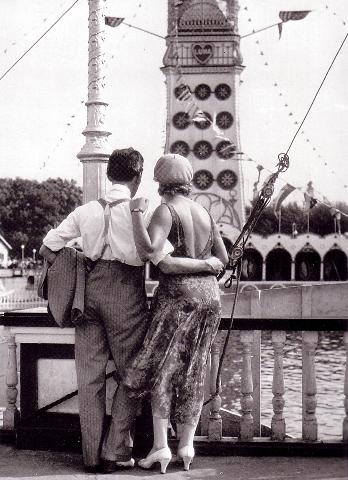 Walker Evans was famed for his work with the Farm Security Association (FSA) where his images captured the poverty that was a result of the stock market crash known as 'Black Tuesday'. This sparked the beginning of what became known as the Great Depression which started in the late 1920's and ended in the late 30's and hit many different countries. Many images from practitioners from this era evoked emotions of sympathy as the Great Depression was such a poignant moment in history. Below is an image of the Fields family in their home in Alabama. This image strikes a huge contrast to the image above, the subjects of the above image are clearly well off as they are dressed well and are enjoying the sight which is amplified by the decisive moment of them being unaware of their photo being taken. The Fields family in contrast look dirty and unhappy, but the image doesn't feel staged. 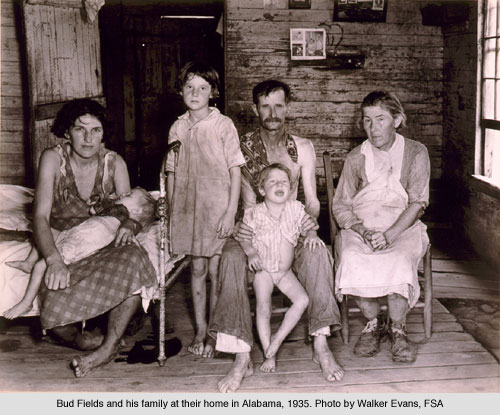 I found Evans' work inspirational, taking normal objects and ideas to paint a picture of life in a place and implanting identity into his pictures and how his portfolio is so contrasting. I think the artistic style of photography he chose to use helped bring forth the relationships between people and objects. Robert FrankRobert Frank was an anthropological photographer, taking a general stance of observing people doing everyday things. Many of his pictures were representations of the vast amount of cultures, beliefs and lifestyles that could be found in America at the time.
I found the emotion in many of Frank's pictures hard to capture but whilst researching I found this quote: 'Black and white are the colors of photography. To me they symbolize the alternatives of hope and despair to which mankind is forever subjected' (link). I interpreted this as him meaning that any event in life has positives and negatives, and that people hang in the balance where life and moods can shift between the two extremes so easily. He then goes on to say: 'Most of my photographs are of people; they are seen simply, as through the eyes of the man in the street', i believe by this he means that when you see someone for a second, you can't possibly read their emotions at that point, but if you take a look more carefully ,which is what Frank gives us the opportunity to do, you can tell the mood of the person a bit more clearly. For instance the image below; the woman is the subject of the image, other people are moving on past her but from an audience point of view, you can get the sense that she feels lonely. 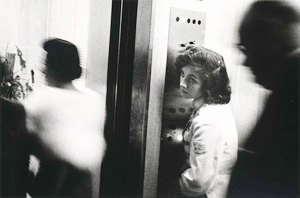 |
